Harley-Davidson's 2026 touring lineup is, by nearly every measurable standard, the best the company has ever produced. The new Milwaukee-Eight VVT 117 engine delivers 106 horsepower and 131 lb-ft of torque. Variable valve timing smooths out the low-end response that older 103 and 107 motors were sometimes criticized for. The Skyline OS infotainment system runs on a 12.3-inch touchscreen. Heated seats come standard on the Limited models. Rockford Fosgate pumps 200 watts through four speakers. It's an impressive package, and Harley should be proud of it.
But here's the thing nobody's really addressing: these machines are enormous. And once you pull into your garage and kill the engine, every one of those upgrades becomes dead weight you have to deal with on your own two feet.

The 2026 touring platform is Harley's most capable ever. Storing it is a different story.
Let's Talk About the Numbers
The 2026 Street Glide Limited has a curb weight of 839 pounds with fuel. The Road Glide Limited comes in at around 826. The CVO Street Glide ST sits at 816 pounds — and that's the "performance" bagger with forged carbon fiber components specifically engineered to shave weight. The standard CVO Street Glide tips the scales at 838. Step into the trike world and the Street Glide 3 Limited checks in at 1,250 pounds. The CVO Street Glide 3 Limited? A staggering 1,283 pounds.
Harley's engineers did trim weight where they could. The Street Glide Limited is about 24 pounds lighter than the outgoing Ultra Limited, and the Road Glide Limited dropped roughly 13 pounds over its predecessor. That's genuine progress, and it matters on the road. But saving 24 pounds on an 839-pound motorcycle doesn't change the fundamental reality of what you're dealing with when the ride is over.
| 2026 Model | Curb Weight | MSRP |
|---|---|---|
| Street Glide | ~802 lbs | $24,999 |
| Road Glide | ~813 lbs | $27,999 |
| Street Glide Limited | 839 lbs | $32,999 |
| Road Glide Limited | 826 lbs | $32,999 |
| CVO Street Glide ST | 816 lbs | $41,999 |
| CVO Road Glide ST | ~810 lbs | $44,999 |
| Street Glide 3 Limited (Trike) | 1,250 lbs | $39,199 |
| CVO Street Glide 3 Limited | 1,283 lbs | $54,999 |
These are curb weights — fuel included, ready to ride. Add a passenger, a loaded Grand Tour-Pak, and a couple of saddlebags packed for the weekend, and you're easily pushing past 1,000 pounds on a two-wheeler. On a trike, you're in small car territory.
The Garage Problem
On the highway, weight disappears. The Milwaukee-Eight VVT pulls you forward, the Showa suspension absorbs the road, and 800+ pounds feels like gliding. That's the magic of good engineering.
In your garage? That magic evaporates.
Picture the scenario most touring riders know too well: you pull in from a ride, the engine ticks as it cools, and now you need to position the bike. Maybe you're threading it past the car. Maybe you need to tuck it against the far wall so your spouse can park. Maybe you've got two bikes and they need to sit side by side in a space that was designed for one SUV and some lawn tools. Whatever the situation, you're now pushing, pulling, and shuffling 800+ pounds of motorcycle on a concrete floor using nothing but your legs, your arms, and the kickstand pivot technique you've been refining for years.
"Every year Harley gives us more reason to ride and no better way to park."
And here's what doesn't get discussed in the review videos: this problem gets worse as the bikes get better. The 2026 Grand Tour-Pak is bigger than the King Tour-Pak it replaced. The new batwing and sharknose fairings are wider. The saddlebag capacity increased. All good on mile 200. All bad when you're trying to make a 90-degree turn in an 8-foot-wide garage aisle.

More fairing, more audio, more luggage — and more weight to manage once the ride ends.
The Real Cost of the Kickstand
Most riders don't think of the kickstand as a storage system. But that's exactly what it is for the vast majority of Harley owners — and it comes with a list of problems that get worse the longer your bike sits.
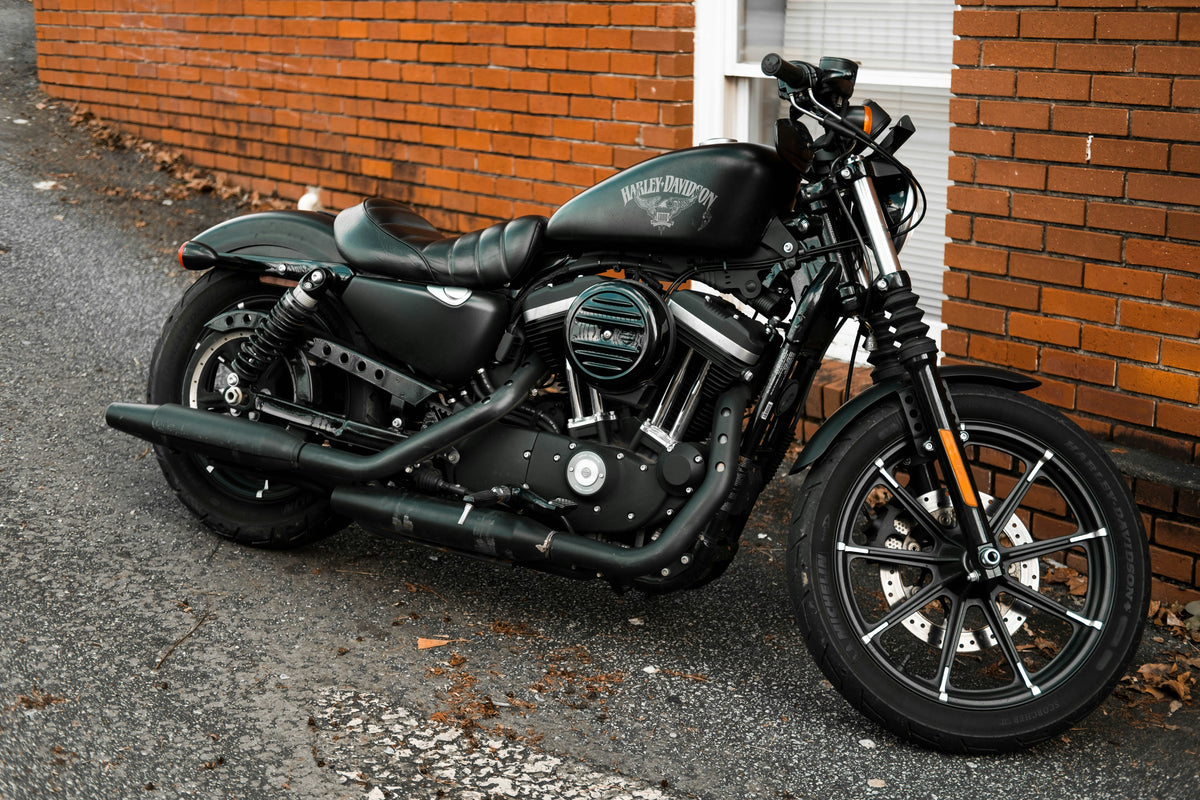
A touring Harley leaning on its kickstand takes up significantly more lateral space than the same bike standing upright. The lean angle pushes the handlebars and fairing out to one side, which means you need clearance on both sides — not just the footprint of the wheels. In a tight two-car garage, that lean can be the difference between fitting the bike and the car, or choosing one over the other.
There's also the issue of what happens to the bike itself during storage. When a motorcycle sits on its kickstand for weeks or months, the weight of the entire machine compresses into one side of the suspension. Tires develop flat spots from bearing the full load in a single contact patch. Fork seals can take a set from the constant lean angle. And if your garage floor has even a slight grade or a smooth finish, there's always the chance the kickstand slips. On an 839-pound bike, that's not a slow-motion tip — it's a fast, expensive problem.
So What's the Actual Solution?
The answer isn't complicated, but it took us a while to get it right.
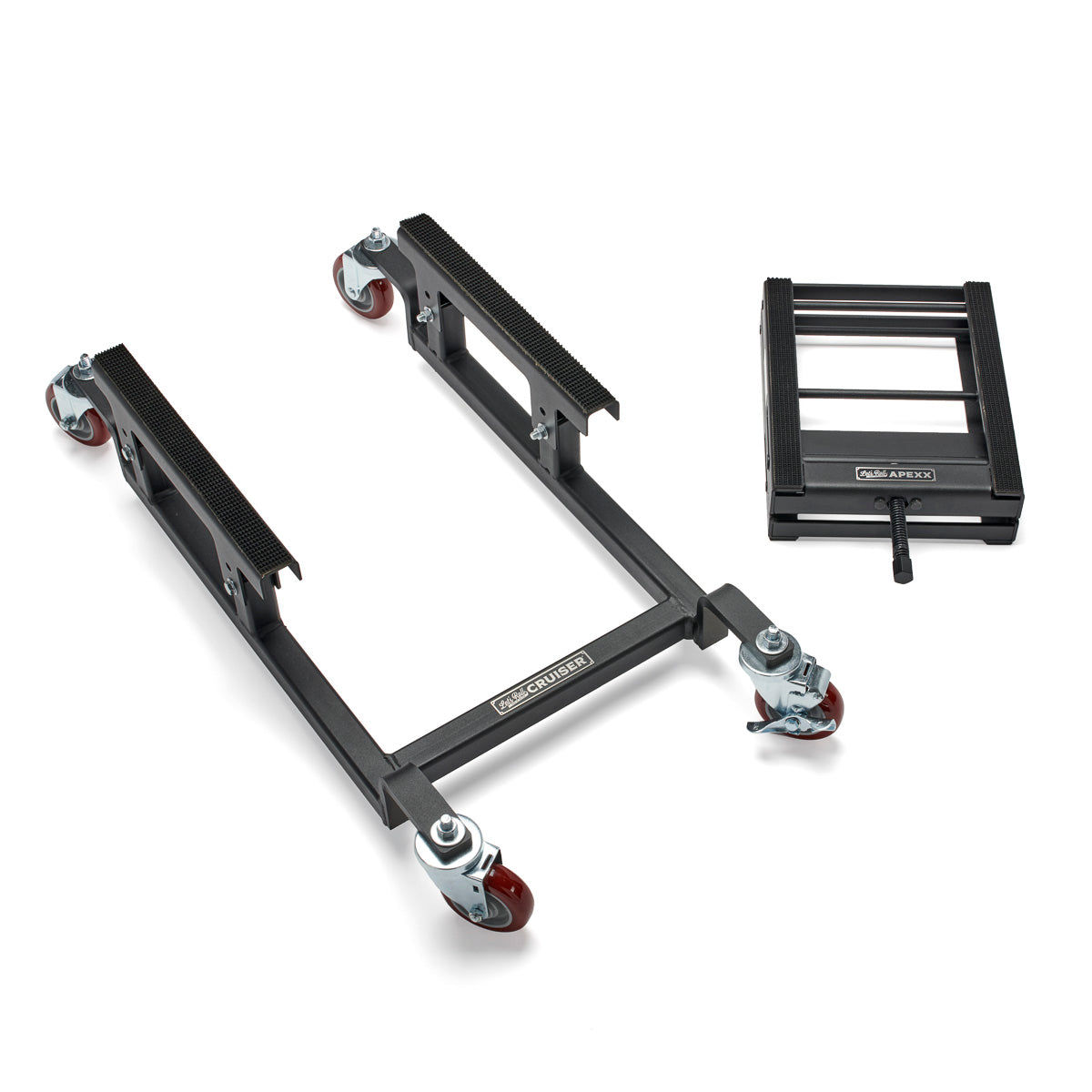
We built the Let's Roll Apexx Lift and Cruiser Dolly specifically for this use case — getting big, heavy touring bikes off their kickstands, off their tires, and into a position where one person can move them anywhere in the garage without a fight.
Here's how it works. The Apexx Lift is a mechanical scissor lift with a 1,200-pound capacity. It sits low enough to slide under your bike's frame while the motorcycle is still resting on the kickstand. You crank it up with a standard drill or a hand ratchet — no hydraulics, no fluid, no pump seals that can leak and let your bike creep down overnight. The lift raises the bike off the ground and positions it onto the Cruiser Dolly. Once it's on the dolly, you remove the lift. That's it — the lift's only job is getting the bike onto the dolly.
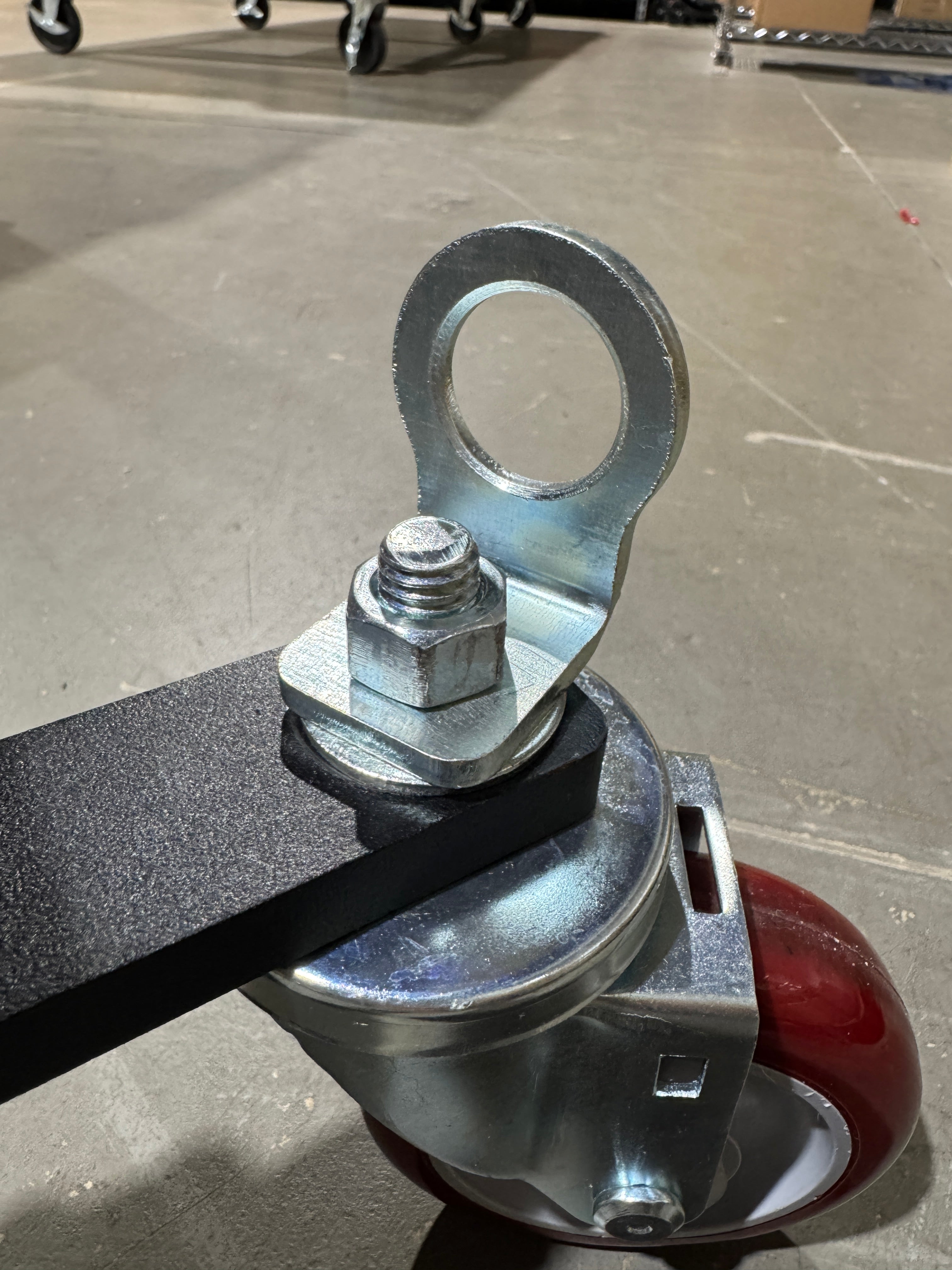
From that point forward, the dolly does the work. It rolls on four-inch Zero-scuff urethane casters that won't mark your epoxy or stained concrete floor. The bike sits upright on the dolly's crossbars, resting on the frame — not the kickstand, not the tires, not the suspension. The industrial rubber padding on the crossbars grips the frame securely enough that no tie-downs or straps are needed. You can push an 839-pound Street Glide Limited with one hand, spin it sideways, and tuck it flat against a wall.
The Apexx Package
Everything you need to lift, move, and store your touring bike. Built from 10-gauge US steel in Southfield, Michigan.
- Apexx Lift — 1,200 lb capacity, mechanical scissor design, replaceable screw and bearing
- Cruiser Dolly — 1,200 lb capacity, 35" x 18" footprint, Zero-scuff 4" urethane casters
- No hydraulics, no tie-downs, no straps required
- Bike sits upright on the frame — tires off the ground, suspension unloaded
- Two of the four casters include built-in brakes
- 30-day money-back guarantee • Lifetime warranty on the dolly
Why It Matters for 2026 Specifically
This year's models make the storage problem more relevant than it's been in a while, for a few reasons.
First, the prices. A Street Glide Limited starts at $32,999. A CVO Street Glide ST is $41,999. The CVO Street Glide 3 Limited is $54,999. These are serious investments, and letting a $33K–$55K motorcycle sit on a kickstand on a potentially uneven garage floor — with all its weight compressing one side of the suspension and developing flat spots on the tires — doesn't make a lot of sense from a preservation standpoint.
Second, Harley is actively targeting riders who want to extend their riding season. The heated seats and grips on the Limited models are marketed as features that let you ride deeper into fall and earlier in spring. That's great. But for a lot of the country, there are still months where the bike sits. Proper storage during those months matters more when the bike is worth more.
Third, the trike segment is growing. Harley completely redesigned its three-wheel platform for 2026 — new de Dion rear suspension, new reverse system, new chassis geometry. These are better trikes than Harley has ever made. They're also 1,250+ pounds, and the riders buying them tend to be the exact demographic that benefits most from not having to physically wrestle a machine around their garage. The Apexx Lift handles 1,200 pounds. The Cruiser Dolly matches that capacity. Between the two, a trike moves like it weighs nothing.
The Boring Stuff That Actually Matters
We're a small company out of Southfield, Michigan — just outside Detroit. The products are made from US steel with a textured matte black powder coat. The Apexx Lift uses a replaceable screw action and bearing so the primary wear parts can be swapped instead of replacing the whole unit. The casters on the dolly are our own Zero-scuff design — four-inch urethane wheels that roll over concrete seams, cracks, and expansion joints without hanging up. If you've ever tried to push a bike on a dolly with two-inch steel wheels, you know why this matters.
The system works with Harleys and Indians. For Indian owners, we make an Indian Motorcycle Adapter Plate (IMAP) that fits between the lift and the frame to accommodate the different undercarriage geometry on most Indian models from 2014 through 2024.
The whole system — Apexx Lift plus Cruiser Dolly — is the Apexx Package. Before you order, measure the undercarriage of your bike. You need 17 inches of clear frame space between the wheels, with no piping, electrical, or exhaust in the way. The lift needs direct contact with the frame or engine block. Our compatibility chart covers most popular models, but measuring yourself is always the best bet.
The 2026 Harleys are exceptional motorcycles. The VVT 117 is the best touring engine Harley has ever built. The Skyline OS is a genuine leap forward in connected riding. The suspension improvements are real, and you'll feel them on your first long ride. None of that changes the fact that when the ride is over, you're standing in your garage with 800+ pounds of motorcycle and a space that wasn't designed for it.
The ride deserves a better ending than a 12-point turn and a prayer that the kickstand holds.