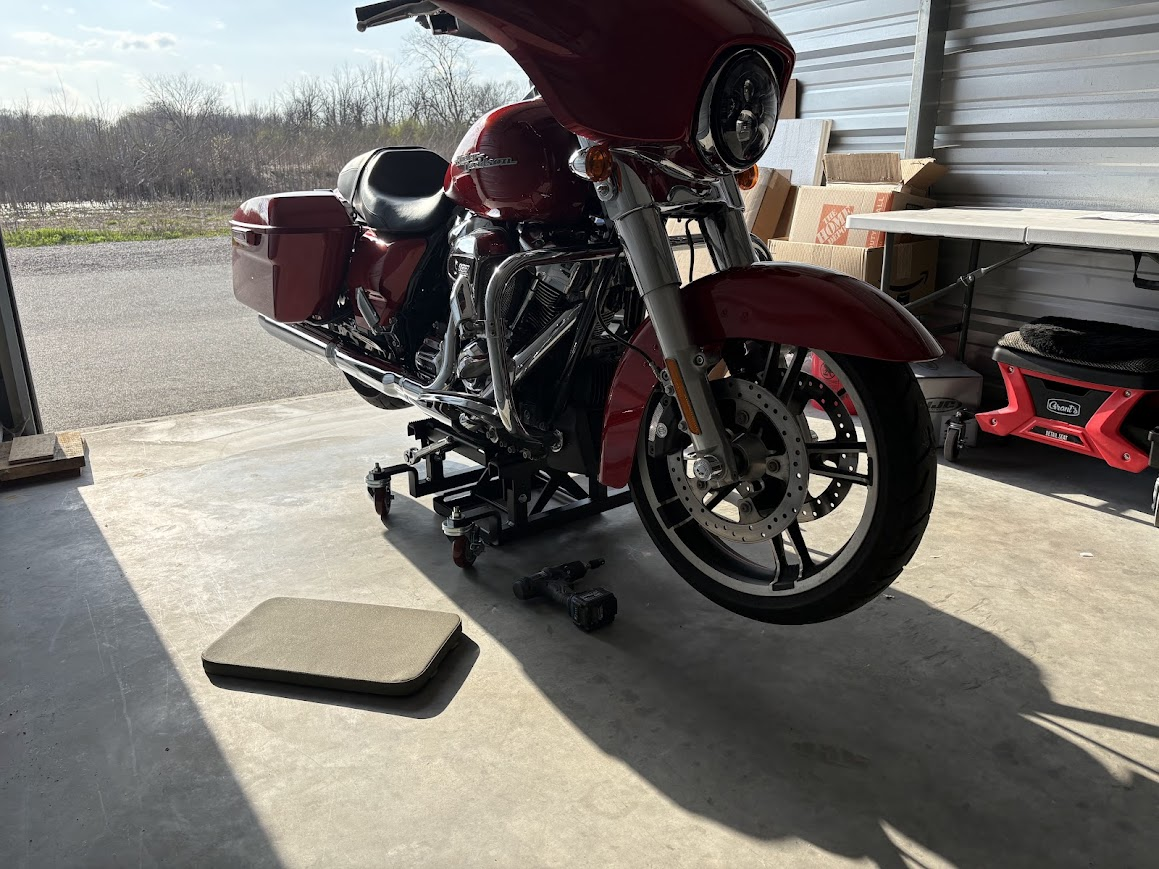
You dropped the bike two inches because it looks right and it feels right. Then oil change day comes around, you slide the jack under, and it stops dead against the frame rail. Nothing you do with the handlebars fixes it.
This is one of the most common complaints on Harley forums, and it almost never gets a straight answer. Riders trade tricks for propping the bike higher, arguing about which end to raise first, and working out ways to lean the bike over far enough to slip the jack in from one side. All of it is effort spent adding back the height they paid to take away.
The problem is simpler than the threads make it look, and so is the fix.
The only number that matters is collapsed height
A jack has two heights: how high it goes, and how low it sits when it's all the way down. Everybody shops the first number. The second one is what decides whether the jack is useful to you at all.
If your bike's lowest hard point sits four inches off the concrete and the jack measures five inches fully collapsed, no technique closes that gap. The jack physically will not go where it needs to go. That's the entire problem, and it's why a jack that works fine on a stock touring bike becomes a garage ornament the week after you install lowering kits.
Once you know your clearance number and the jack's collapsed number, the decision takes about ten seconds.
The frame rail isn't always what's stopping you
Before you measure, know what you're measuring to. On a lowered bike, the first thing the jack hits is often not the frame at all:
- Exhaust. Aftermarket pipes routinely hang below the frame rails, and on a dropped bike they become the lowest point by a wide margin.
- Floorboards and highway peg mounts. They sit outboard of the rails, which puts them right in the path of a jack sliding in from the side.
- Rear shocks. On some Softails the shock bodies protrude slightly past the frame rails. Riders think they have a height problem when what they actually have is a width problem.
- Oil pan. Sits low and center, right where a jack pad wants to be, and it is not a lifting point.
- The jiffy stand lean. Your bike isn't sitting level when you approach it. It's leaned over, which drops the kickstand side another inch or more and closes the gap on the exact side you're trying to come in from.
That last one catches people constantly. They measure with the bike leaned, get a number that seems impossible, and give up. Measure it upright.
Measure your clearance
Two minutes, one tape measure, and a second set of hands if the bike is heavy.
- Park on flat, level concrete. A sloped driveway will give you a number you can't trust.
- Bring the bike upright off the jiffy stand and hold it there. This is the position it will be in when the jack goes under, so it's the only position worth measuring.
- Find the lowest hard point under the bike between the front and rear wheels — frame rail, pipe, board mount, whichever hangs down furthest.
- Measure from the floor to that point. Write it down.
- Subtract a quarter inch for working room. Whatever's left is the tallest jack that will physically slide under your bike.
Most riders who do this on a lowered bagger or Softail land somewhere between four and five inches. That's a narrow window, and it's why so many jacks don't clear.
What we built to fit that window
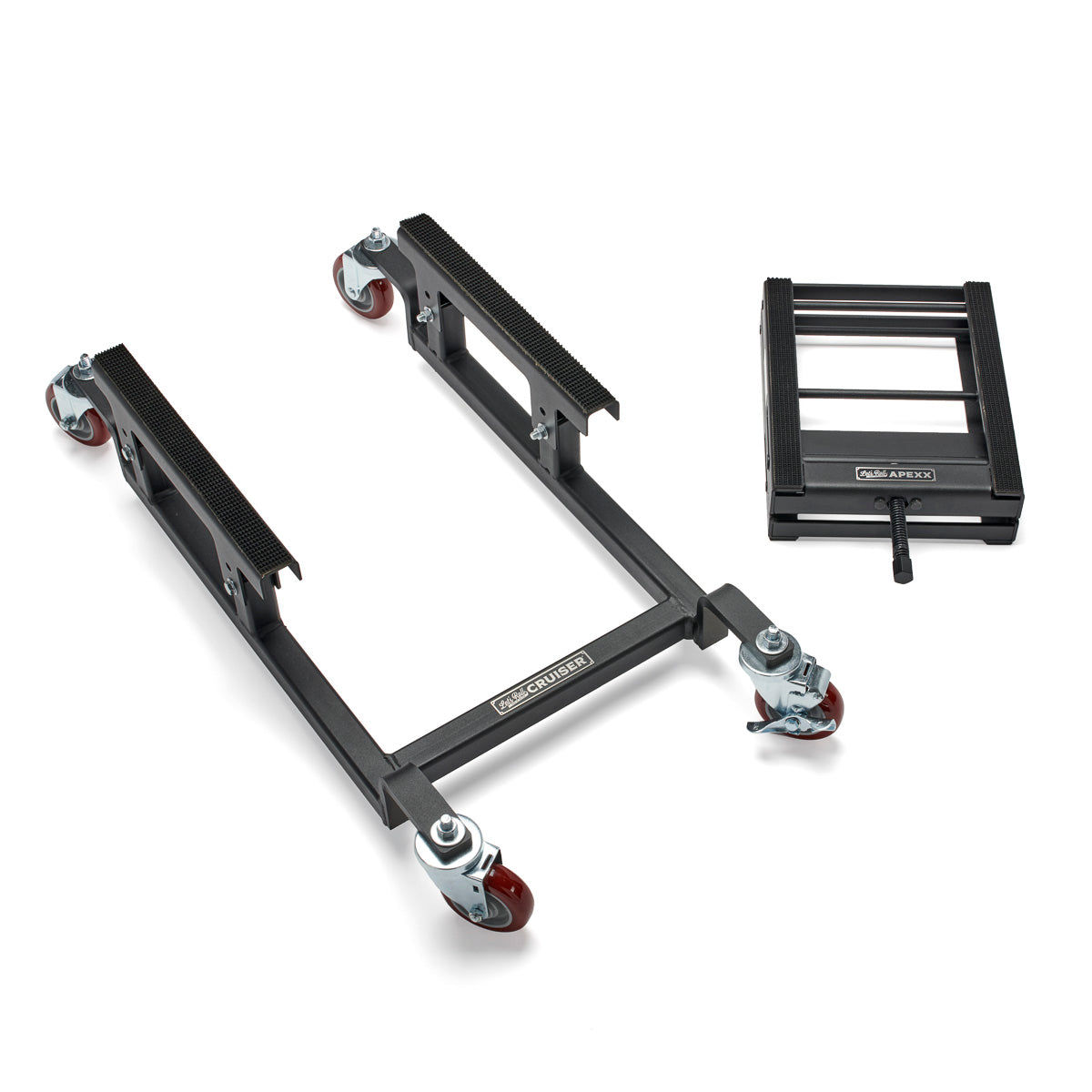
The Apexx Jack measures 15" x 12" x 3.85". The 3.85 is the one to pay attention to.
That's under four inches at rest, which puts it below the clearance number most lowered Harleys measure out at. It slides in without a prop, without a lean, and without a two-person production every time you want to pull a wheel or drop the oil.
The 15" x 12" footprint matters for a second reason. A jack that's short front to back can be positioned precisely at the balance point instead of wherever the frame will let it fit — and finding that balance point is the difference between the bike coming up level and the bike coming up on one wheel.
Why the Apexx over the Standard
The Standard Jack handles a couple of oil changes a season without complaint. The Apexx is built around a replaceable ball-bearing screw, which is what you want if the bike is on the jack often — a rider doing his own tires, belt work, and winter storage, or a shop running the same jack every week. When the screw eventually wears, you replace the screw instead of the jack.
Getting it up is half the job
Clearance gets the jack under the bike. It doesn't keep the bike on the jack.
Strap it down before you touch a wrench, every time, even for a quick look. Riders on the forums describe the same failure over and over: the load sits slightly off the balance point, the bike shifts under the force of a stubborn axle nut, and it goes from stable to sideways with no warning in between. A rear wheel pull is the worst offender, because the moment the wheel comes off, the back end unloads and the bike wants to pitch forward.
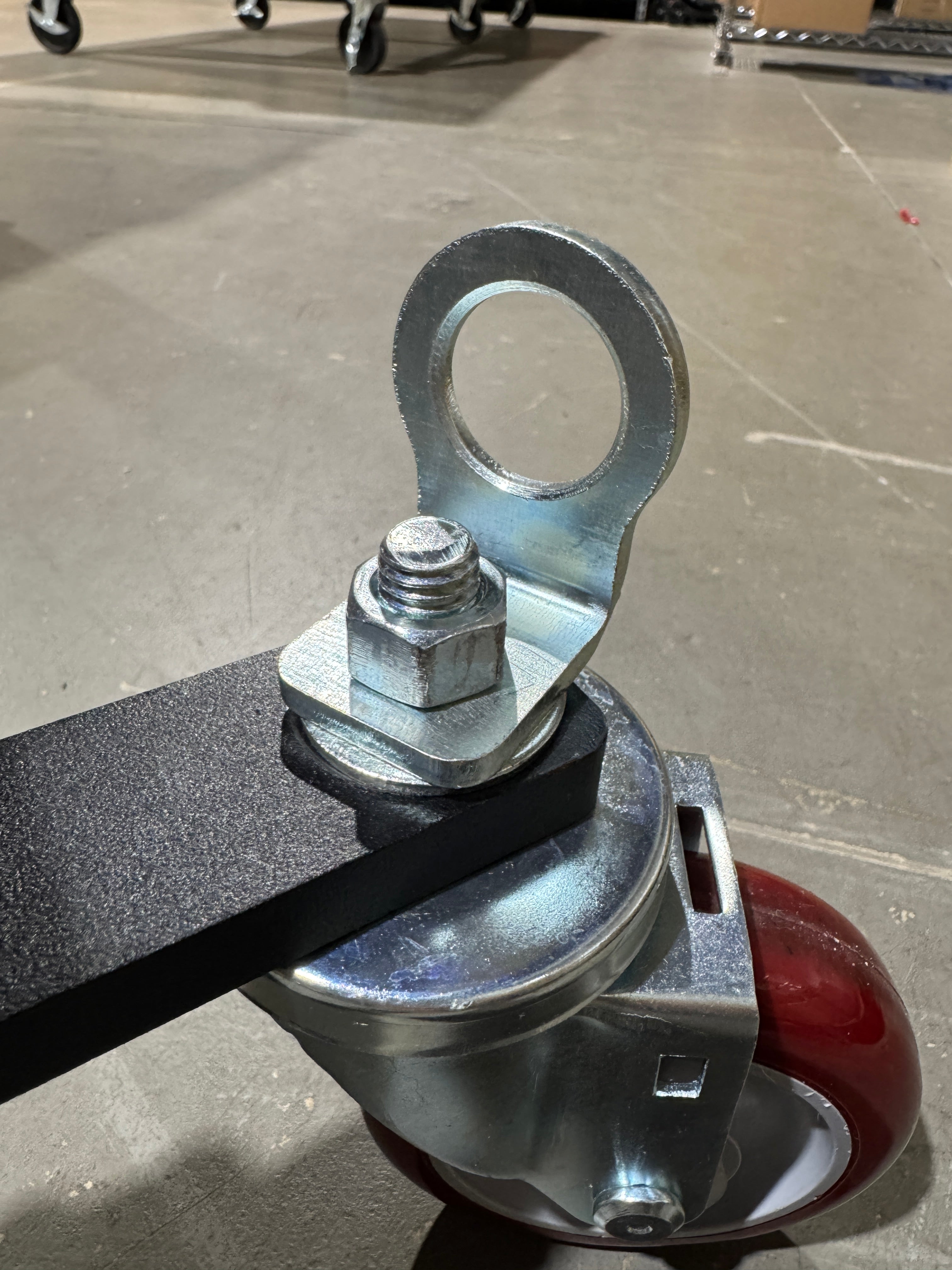
Run straps to solid points on the frame at the front and to the crash bar or bag support juncture at the rear, and keep the jiffy stand down while you're raising and lowering. If your bike doesn't give you a clean anchor point, our Eyelets add one.
Measure once, then decide
If your number came in above 3.85", the Apexx Jack goes under your bike. If you also need to move the bike once it's down — against the wall, out of the car's way, into a corner for the winter — the package pairs it with the Cruiser Dolly.
Shop the Apexx Jack — $449 See the Apexx Package — $834Built and shipped from Detroit. American steel, 1,100 lb capacity.