
Garage Setup
5 Must-Haves for Every Motorcycle Owner's Garage
Ask ten riders what belongs in a garage and you'll get ten different answers — usually a lot of chrome and not much that actually gets used. This is the short list. Five things that earn their floor space on a 700–900 lb cruiser or bagger, in the order we'd buy them.
Everything here is linked straight to the maker or to our own store, so you can go look for yourself.
Start Here · Let's Roll
A Jack and Dolly That Handle a Heavy Bike
Nothing else on this list matters if you can't get the bike where you need it. A heavy cruiser parked on its kickstand eats a full bay, sits at an angle, and leaves the suspension loaded all winter. Get it up, get it level, and get it rolling — everything downstream gets easier.
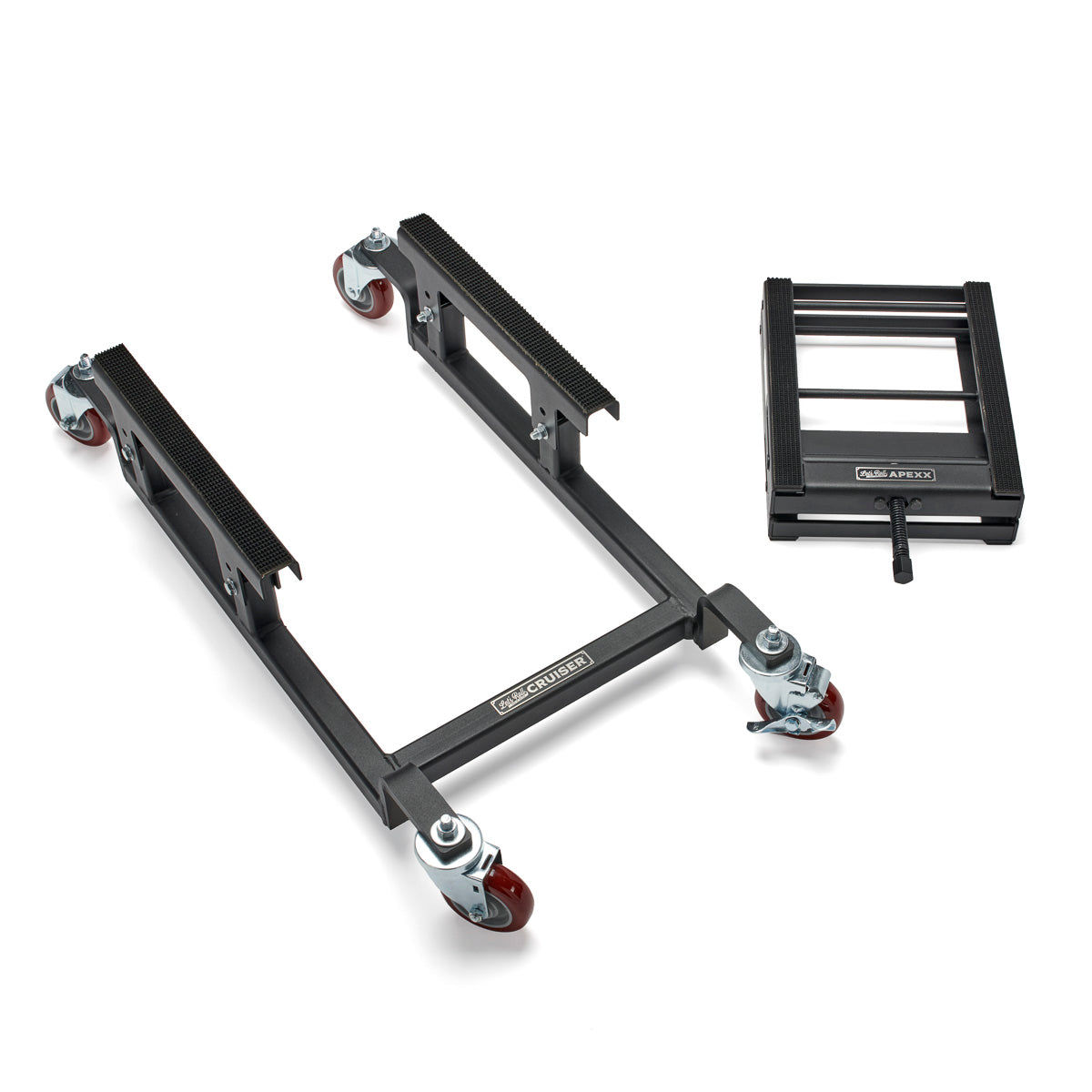
That's the whole reason the Let's Roll jack and dolly exist. The jack picks the bike up off the frame. The dolly takes the weight and rolls it wherever you want it, tires off the ground, bike upright, no tie-downs. Both are made in the USA and shipped out of Detroit.
- Capacity 1,100 lbs
- Jack 14" x 12", sits 3.85" high with the felt, raises to 10.5"
- Cruiser Dolly 35" x 18", adjustable 8.5" to 10", Zero-scuff™ wheels, two casters with brakes
- Before you order You need 17" of clear frame between the wheels, nothing hanging down to block contact
Which package? The Standard Package is the one to get if the bike comes off the ground a handful of times a year — winter storage, an oil change, a detail day. The Apexx Package upgrades to the Apexx Jack, which uses a replaceable ball-bearing screw built for frequent heavy-duty use. If you're in the garage every weekend, or you're moving more than one bike, that's the one.
Tight on space? Both the jack and the dolly hang flat on a wall when you're done with them. Our Wall Rack mounts to 16" or 24" studs and keeps them off the floor.
Lighting & Reference
Light You Can Actually Work Under — and the Book for Your Bike
You can't fix what you can't see. Most garages run one bulb in the middle of the ceiling, which means every job happens in your own shadow — and a bagger parked in the bay throws a big one. The other half of the same problem: most riders are guessing at torque specs off a forum post from 2011.
Do the ceiling first. Linkable 4-foot LED shop lights are what riders actually end up running, and it's not close. They daisy-chain off one outlet, mount with a hook or straight to the ceiling, and you can put light on both sides of the bike instead of one pool in the middle. Two rules: go 5000K daylight, because it renders color accurately and you want to see what the paint is actually doing, and buy enough of them. Figure roughly 50 lumens per square foot — a typical two-car garage lands around 400 to 500 square feet, which is four to six fixtures, not one.
If you can't run fixtures — rented garage, no outlet up there, don't want the project — a screw-in multi-panel light is the honest second choice. STKR's TRiLIGHT 2.0 twists into a standard E26 ceiling socket and puts 5,000 lumens across three aimable panels, with motion activation you can switch off so your wall switch still works. It's a real upgrade over a 60-watt bulb. It's still one point of light, so it won't kill shadows the way a row of shop lights will.
Then get one light you can move. Overhead lighting doesn't reach behind the primary, under the tank, or up into the frame. A rechargeable magnetic work light sticks to the frame or the dolly and puts light exactly where your hands are. The Milwaukee M12 ROVER is the one you'll see in most shops; STKR's FLEXiT panels do the same job cheaper.
Now the book. Get the service manual for your exact year and model. Clymer is the standard for V-twins — every manual is built from a complete teardown and reassembly of the bike, with hundreds of original photos, thumb-tabbed chapters, and large two-column text you can read with greasy hands. Torque values, service intervals, wiring diagrams. It pays for itself the first time you don't have to call the dealer.
- Color temp 5000K daylight — anything warmer hides what the finish is doing
- How much About 50 lumens per sq. ft.; four to six 4-ft fixtures for a two-car bay
- Placement Run them alongside where the bike sits, not directly over the center
- Also get One rechargeable magnetic light for everything the ceiling can't reach
Cleaning & Detailing
Cleaner That Won't Wreck Your Finish
Bugs bake on. Chain fling gets on the bag. Somebody's kid puts a handprint on the tank. The problem with most garage cleaners is that they're built for a car — too aggressive for denim paint, too streaky on chrome, and useless on the plastic and Lexan you've got all over a bagger.
BugSlide is the one we stock, and we stock it because it's what riders keep asking for. It's a waterless detailer that cleans, degreases, and shines in one pass, leaving a microscopic protective layer that repels dust, water, and fingerprints. It's body-shop safe with no wax, petroleum, silicone, Teflon, or ammonia, and it's safe on paint, chrome, glass, plexiglass, vinyl, and leather — including Harley denim paint.
Waterless matters more than it sounds. It means you can wipe the bike down where it sits — on the dolly, in the bay — without dragging out a hose in February.
- Start with the 16 oz Shop Kit for the garage
- Add a 32 oz refill so you're not rationing it
- Toss in a 4 oz travel bottle for the saddlebag
Electrical
A Battery Maintainer on the Wall
Dead battery in March is the single most preventable problem in motorcycling. A bike that sits from October to April will self-discharge and sulfate, and by spring you're buying a battery instead of riding.
A maintainer is not a trickle charger. A trickle charger keeps pushing current whether the battery needs it or not; a Battery Tender monitors the battery and adjusts, then drops into float mode at 100% so it can stay connected for three weeks or six months without overcharging. Riders hook up in October and unhook in April.
Two things to get right: pick the model that matches your battery chemistry — the standard Junior covers lead-acid, AGM, and GEL, while the Multi-Chemistry version adds a lithium mode for factory or aftermarket LiFePO4 batteries — and mount the ring terminal harness permanently to the battery. That way hooking up takes seconds instead of pulling a side cover every time.
Tools
A Bike-Specific Tool Kit and a Torque Wrench
A drawer full of automotive sockets will get you about halfway through a Harley job before you hit a Torx head or a size you don't own. A bike-specific kit skips that. The CruzTOOLS RoadTech H3 is built around Harley and American V-twin fasteners — combination wrenches, mini ratchet and sockets, hex and Torx keys, spark plug socket, adjustable wrench, locking pliers, tire gauge, all in a roll-up pouch with a lifetime guarantee. CruzTOOLS makes metric cruiser and BMW versions too if you're on an Indian, a Gold Wing, or a Vulcan.
The kit lives in the saddlebag. The torque wrench lives in the garage. Buy a click-type in the range your manual actually calls for — most cruiser fasteners land somewhere between 10 and 100 ft-lbs, so a 3/8" drive covers the majority of what you'll touch. Then use the manual from item two and stop guessing.
Shop habit worth building: back the wrench off to its lowest setting when you put it away. A click-type left under spring tension drifts out of calibration.
Build It in This Order
You don't need all five this weekend. But the order matters — the jack and dolly change how you use the whole space, and everything after it is easier once the bike is up, level, and rolling.
- Jack & dolly
- Overhead light & service manual
- Waterless cleaner
- Battery maintainer
- Tool kit & torque wrench
Start at number one and the rest of the garage falls into place.
Product links go to the manufacturer's site or to our own store. Specifications and pricing were accurate at the time of writing — check the product page before you buy.