
Street Glide vs. Road Glide
One fairing is bolted to the forks. The other is bolted to the frame. That single difference divides the Harley touring world in half — and the debate just got fresh fuel with Harley's 2026 Limited updates. Here's everything you need to know.
Ask any Harley rider which is better — Street Glide or Road Glide — and step back. You'll get an answer immediately, and it will be delivered with conviction. This is the one motorcycle debate that never settles, because both sides are right.
The 2026 Limited lineup just poured fuel on it. Harley dropped 13 pounds off the Road Glide Limited and 24 pounds off the Street Glide Limited, added variable valve timing to the Milwaukee-Eight 117 across both, and gave both bikes a fully refreshed fairing, new wheels, and an upgraded Skyline OS infotainment system. Two bikes. Same engine. Completely different personalities. Fresh reviews are flooding in from every major motorcycle outlet, and riders everywhere are picking their side all over again.
So let's break it down — what actually separates them, who belongs on which bike, and what both have in common no matter which one you choose.
The One Difference That Changes Everything
On paper these bikes are almost identical. Same engine. Same chassis. Same tech. Same price range. But one component splits them into two completely different riding experiences: where the fairing is mounted.
The Street Glide carries the iconic batwing fairing on the forks. It turns when you steer. You feel it. Your handlebars carry its weight. That connection is exactly what Street Glide riders love — it's communicative, direct, and feels like a classic Harley. You're in the ride, not watching it.
The Road Glide locks the sharknose fairing to the frame. The handlebars move independently of it. That means lighter steering at speed, no wind-catch in crosswinds, and dramatically less fatigue on long hauls. The Road Glide doesn't disappear — it just doesn't fight you. Every mile past 300, Road Glide riders feel this difference in their shoulders.
What They Share: The 2026 Updates That Matter
Before you pick a side, know what you're getting on either bike. For 2026, Harley made meaningful upgrades to both the Street Glide and Road Glide — not just in the Limited versions, but across the lineup. The headline is the engine, but there's more worth knowing.
The VVT engine is the real story. Variable valve timing was previously exclusive to CVO models — this is the first year it's available on standard production touring bikes. The result is a 14% horsepower increase and 7% more torque over the outgoing 2024 models, with improved heat management and better fuel efficiency to go with it.
Who Each Bike Is Actually For
The honest answer is that you need to ride both. But here's what the real-world data says about who ends up on which bike.
Street Glide riders tend to do a mix of riding — weekends, day trips, some longer touring, but also regular day-to-day use. They value the classic look, appreciate the connected steering feel, and often come from a background of riding that puts a premium on how a bike handles rather than how long you can ride it before your arms give out. The Street Glide is the most popular bagger in the Harley lineup for a reason: it does everything well without specializing in anything.
"Street Glide owner rides Road Glide for the first time."
— Active thread title, HD Forums Touring section, this weekRoad Glide riders are typically putting on serious miles. Multi-day tours, cross-country runs, loaded up two-up. When you're logging 400 miles in a day, the fixed fairing stops being a quirk and becomes the reason you're not exhausted at the end of it. Wind buffeting on a fork-mounted fairing compounds over distance. Crosswinds that feel like a minor annoyance at mile 50 feel like a wrestling match at mile 350. The Road Glide removes that entirely. Taller riders also frequently find the Road Glide's cockpit more comfortable — there's simply more room in there.
One review this week put it plainly: after riding both back-to-back at Harley's international press launch, the Road Glide edged it for stability and riding position — but noted that on paper they're nearly identical, and the decision really comes down to how you actually ride.
Whichever You Choose — You Need to Move It
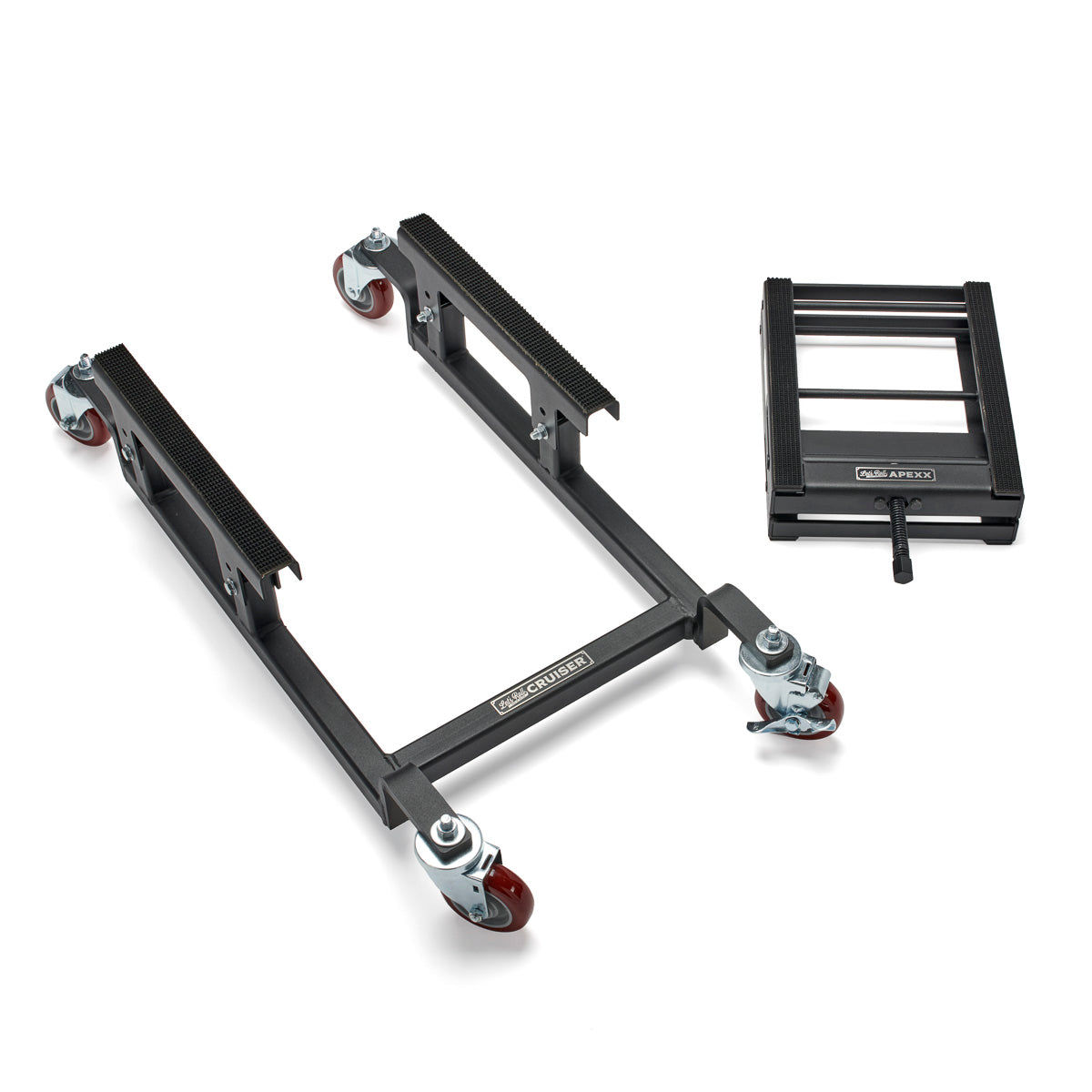
Street Glide or Road Glide, you're working with a 873–905 lb motorcycle. Getting it on and off a lift, repositioning it in a tight space, rolling it to the back of your garage — none of that is casual. The Let's Roll Cruiser Dolly was designed for exactly this. Use the lift to raise the bike, roll the dolly underneath, lower the bike onto it, and move your Glide anywhere in your space with one hand. Four heavy-duty casters. Low-profile frame. Zero wrestling. Works with both bikes.
See the Cruiser DollyThe Debate in the Real World
What makes this argument interesting is that it rarely resolves on specs. Riders who love the Street Glide will tell you the Road Glide's fixed fairing feels "disconnected" — like you're not fully piloting the bike. Riders who love the Road Glide will tell you the Street Glide's fork-mounted fairing turns every crosswind into a workout. Both are describing the exact same physical difference, and both are completely right.
The customization culture doesn't simplify things either. Both bikes support massive aftermarket ecosystems — exhaust, seats, wheels, handlebars, audio, lighting, suspension. A fully built Street Glide and a fully built Road Glide don't look like the same bike at all. Your Glide ends up looking like you, not like a catalog photo. Both platforms support that equally.
There are a few practical differences that do lean toward one or the other. The Road Glide's fairing compartments in 2026 are deeper — they'll hold a one-liter water bottle. The Street Glide's are boxier and less useful for long-trip essentials. The Street Glide is 24 pounds lighter in Limited trim, which is noticeable when you're maneuvering in a parking lot. The Road Glide's dual headlights give it a look that commands attention in a way the Street Glide's single-light setup doesn't.
None of these are dealbreakers. They're texture.
The Lift Gets It on the Dolly
The Let's Roll lift does one thing: it raises your Street Glide or Road Glide off the ground so the Cruiser Dolly can slide underneath. Lower the bike onto the dolly and you're mobile — every direction, with one hand. The lift is the setup. The dolly is the system. Together, they change how you store and move your bike entirely. Available as the Standard Package (lift + dolly) or the Apexx Package with the upgraded Apexx Lift. Both work with the Street Glide and Road Glide. Made in Detroit. 100% satisfaction guarantee.
See the Standard & Apexx PackagesDoes the 2026 Limited Change the Math?
If you're on the fence, the 2026 Limiteds tip the scales slightly. Both are genuinely excellent motorcycles that received meaningful engineering improvements — not just a paint refresh and a price bump. The VVT engine is the biggest, but the weight savings are real, the infotainment is better, and the suspension work is noticeable.
But the Limited versions start at $32,999 — the same price for both. If you're spending that, your decision really comes down to how you ride, because the feature list is nearly identical. The fairing choice matters more at this level than it does at any other, because you're buying a machine built to go far. And the farther you go, the more that fairing choice defines your day.
For riders buying the standard Street Glide ($24,999) or Road Glide ($27,999), the advice is the same: test ride both. Don't trust anyone else's preference, including this one. The difference in how they feel is subtle enough in the first mile and obvious enough in the first hundred that only the road will tell you.
Two Packages. One Decision. Works With Both Bikes.
Whether you go Street Glide or Road Glide, the workflow is the same: lift gets it up, dolly moves it around. Let's Roll makes two complete packages built around that — one for every rider, both made in Detroit.
The Verdict
There is no wrong answer here. The Street Glide is the most popular bagger Harley makes for a reason — it's versatile, iconic, and handles like something that wants to be ridden hard. The Road Glide is the choice for riders who measure their trips in days, not hours — it removes fatigue so you can do more of what you bought the bike to do.
Get on both before you decide. Every dealer has them. The difference is real, it's physical, and no article will communicate it as well as ten minutes on the road will. Trust the ride, not the spec sheet.
And when you get one home — whichever one it is — you're going to need to move it.
Built for
Your Glide.
The Let's Roll lift raises it. The dolly moves it. One hand, any direction, no help needed. Made in Detroit for the riders who take their bikes seriously — Street Glide and Road Glide both.